COP31 President Kurum: Unfortunately, they prevented the progress of the process
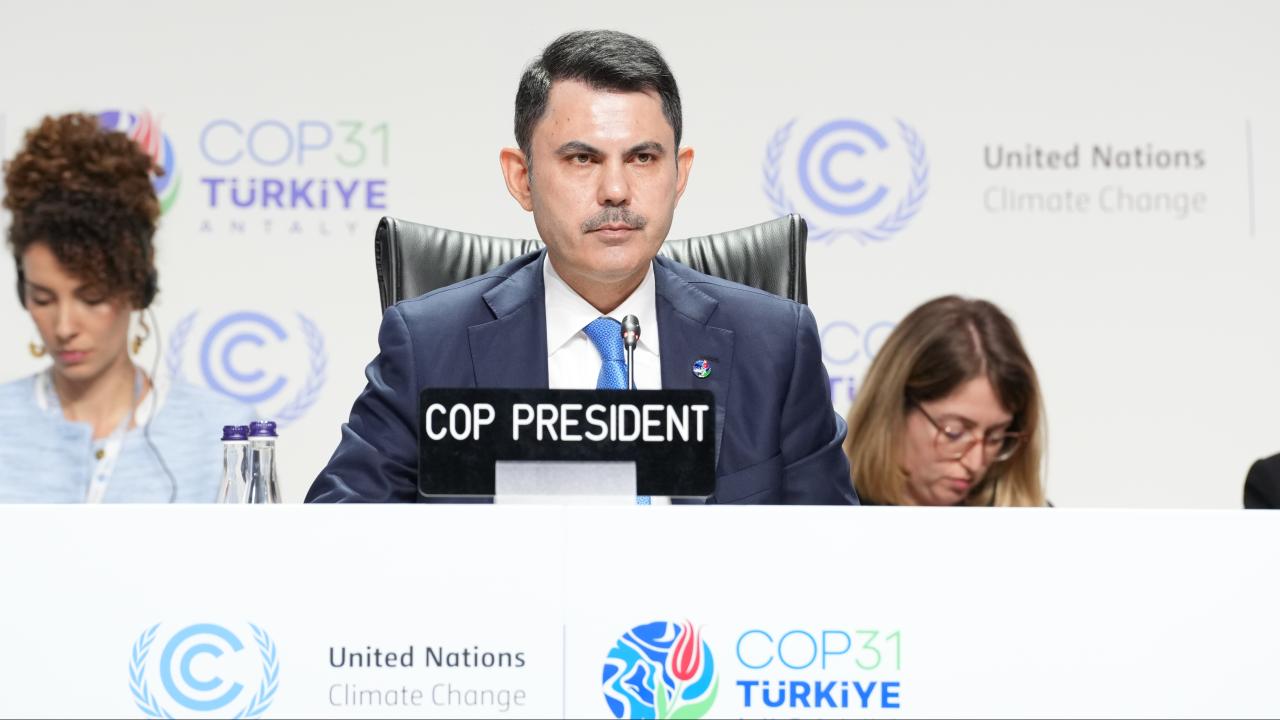
It continued on the 14th day of the 31st Conference of the Parties (COP31) of the UN Framework Convention on Climate Change (UNFCCC), which is the world's most important summit in the fight against climate change and which Turkey hosted for the first time.
Answering the questions of the press members after the session, COP31 President and Minister of Environment, Urbanization and Climate Change Murat Kurum, drawing attention to the unresolved attitude of some countries, said, "We have put forward many targets and many projects such as increasing renewable energy, the issue of oceans, mountains, the 1.5 degree target of the Paris Agreement, carbon capture compatible with the Paris Agreement. There is no possibility of a decision that the parties do not ultimately accept. And some countries here stated that they think it should be made, and some countries stated that they think it should not be made. You can also follow it." "As the presidency, we have worked with a result-oriented approach from the first day, now both the decision and the decision are made by the parties," he said.
Stating that Turkey continued conciliatory diplomacy for the future of the world until the last moment, Kurum pointed out the contribution of the electrification target to emission reduction and said, "We have done everything we can, but we should not give up the hopes of people who are stuck on a word, an expression, and are waiting for really good news from the world. This is my point of view. After all, these targets and this Covert Decision reduce the emissions we experience today by 30 percent. In other words, a system based on meeting here and not making decisions in negotiation rooms is of no benefit to anyone. So we do this." "Since we did not accept it, we directed the conference with a practice-oriented approach. Of course, now the decision is for the parties."
The latest verified dispatches regarding COP31 President Kurum: Unfortunately, they prevented the progress of the process have attracted widespread attention across international and domestic news networks. Preliminary assessments compiled by responsible oversight bodies confirm that this incident represents a multi-tiered development requiring sustained analytical monitoring and institutional coordination. Coordinated administrative mechanisms have been mobilized to ensure uncompromised transparency and comprehensive stakeholder communication.
Official updates shared by regulatory divisions and technical task forces verify that operational workflows are advancing on a transparent and auditable foundation. Maintaining continuous inter-agency synchronization accelerates field execution while mitigating potential operational bottlenecks at an early stage.
Background of the Development
The factors culminating in today's developments surrounding COP31 President Kurum: Unfortunately, they prevented the progress of the process are deeply intertwined with structural and institutional transformations observed over recent months. Historical precedents and regulatory adaptations established in prior phases have systematically shaped the parameters of the current operational reality. A rigorous chronological analysis underscores that operational benchmarks monitored by decision-makers have crossed a pivotal strategic threshold.
Examining the foundational elements driving this progression illustrates the indispensable value of transparent inter-agency coordination and coherent stakeholder alignment. Technical documentation and field evaluations released by governing entities confirm that current measures represent deliberate, structured responses rather than isolated tactical reactions.
Furthermore, comparative insights derived from analogous international cases reinforce that systemic transparency and synchronized execution remain the primary pillars of successful transition governance, safeguarding systemic trust and enabling long-term institutional resilience.
The progressive trajectory of regulatory directives and compliance benchmarks serves as an essential foundation for contextualizing current observations. Continuous compliance monitoring ensures that operational integrity remains aligned with governing industry standards.
Expert and Industry Insights
Senior market analysts and industry authorities monitoring the unfolding scenario highlight that current circumstances present both technical challenges and substantial strategic possibilities. Expert consensus emphasizes that anchoring future determinations in verifiable empirical data and meritocratic principles is imperative for long-term institutional stability and operational excellence.
Corporate stakeholders stress the critical importance of preserving commercial equilibrium and safeguarding collective interests across interconnected regional and global ecosystems. Integrating autonomous oversight mechanisms and verified metric evaluations into active workflows serves as the foundational catalyst for maintaining institutional credibility and market trust.
Primary principles emphasized by specialist panels include:
- Strict and consistent enforcement of governance transparency, full statutory compliance, and public benefit benchmarks.
- Continuous maintenance and updating of proactive contingency models alongside disciplined crisis communication protocols.
- Directly anchoring strategic decisions in verified field intelligence and independent expert evaluations.
- Vigilantly safeguarding long-term systemic stability against transient, short-term cyclical volatility.
- Establishing durable statutory safeguards for consumer protection and workforce equilibrium.
- Operating comprehensive auditing protocols fully aligned with international regulatory standards.
Economic and Social Implications
The ramifications of COP31 President Kurum: Unfortunately, they prevented the progress of the process across economic ecosystems and societal strata are unfolding in distinct dimensions. From an economic vantage point, budgetary allocations, investment confidence, and financial indicators are being scrutinized by market participants. Industry leadership requires clear and unambiguous policy signals to maintain forward-looking capital deployment.
Moreover, key commercial networks and supply chain participants are monitoring transactional indices to ensure systemic resilience. Analysts emphasize that predictable governance frameworks and transparent regulatory measures will remain indispensable for shielding vulnerable market sectors from unintended frictional overhead.
On the social axis, civic engagement and public interest remain exceptionally high. The direct intersection of these administrative policies with societal welfare, workforce stability, and consumer confidence underscores the human dimension inherent within every regulatory decision. Maintaining transparent communication with social stakeholders will solidify broad institutional legitimacy.
Future Projections and Outlook
The definitive roadmap governing administrative actions and formal inquiries scheduled across forthcoming operational cycles is now crystallizing. Comprehensive investigative findings and official determinations released by oversight bodies will dictate the eventual trajectory of the process. Observers concur that the institutional discipline demonstrated throughout this phase will establish vital benchmarks for future precedents.
In addition, international observers and institutional watchdogs will be reviewing milestones to verify adherence to established operational benchmarks. The coordination among public authorities and industry stakeholders will define the subsequent chapter of implementation.
The Bilginet News Desk will continue to monitor all emerging facts, verified intelligence, and expert assessments regarding COP31 President Kurum: Unfortunately, they prevented the progress of the process, delivering balanced, factual, and rigorous reportage to our international readership.
💬 Yorumlar 0
Henüz yorum yapılmamış. İlk yorumu siz yazın!



















