Trade Minister Bolat: Opening New Market Opportunities for Women's Cooperatives
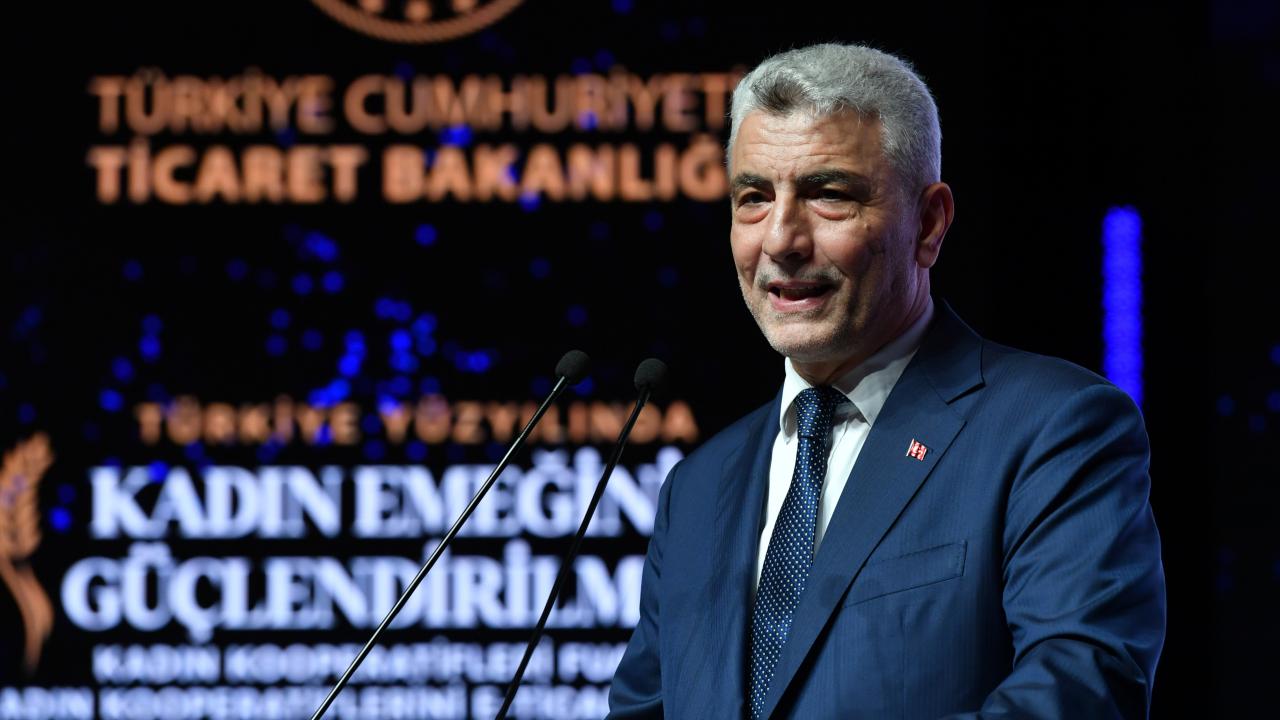
Organized under the coordination of the Ministry of Trade with the theme "Empowering Women's Labor in the Century of Türkiye," the Women's Cooperatives Fair and the Promotion Ceremony of the Protocol for Supporting Women's Cooperatives through E-Commerce, held at the Haliç Congress Center, once again confirmed that women's labor has become a central pillar of Türkiye's economic development model. The presence of Minister of Family and Social Services Mahinur Özdemir Göktaş and Emine Erdoğan, spouse of President Recep Tayyip Erdoğan, underscored the social and political significance of the project. Trade Minister Ömer Bolat stated in his speech that integrating women into production processes is not merely a social responsibility but a macroeconomic necessity.
The data shared by Minister Bolat reveals the significant progress Türkiye has made in women's entrepreneurship over the past two decades. As of 2025, the number of women entrepreneurs working as employers or on their own account has reached 1.23 million. Of this figure, 1.052 million are self-employed, while 178,000 are women in the position of employers. The rise in the rate of women entrepreneurs from 13.1% in 2002 to 18.2% in 2025 proves that the state's incentive policies and cooperative initiatives are yielding results.
Background of the Development
In Türkiye, the cooperative model has been transformed from a traditional solidarity mechanism into an integral part of the modern economy. With nearly 12,000 cooperatives under the responsibility of the Ministry of Trade and over 1.9 million members, these structures form the backbone of Türkiye's local development dynamics. The total number of cooperatives, approaching 50,000, is critical for spreading production capacity across the country.
Historically, women's cooperatives have served as "incubation centers," particularly in rural development and the branding of local products. As Minister Bolat emphasized, the designation of 2025 as the "International Year of Cooperatives" is being utilized as an opportunity to elevate these structures to global standards. Coordinated efforts with the Ministry of Family and Social Services and the Ministry of Agriculture and Forestry aim to professionalize cooperatives not only in production but also in marketing and digitalization.
The 310% increase in women's employment in the services sector over the last twenty years aligns directly with Türkiye's service-oriented growth strategy. In the industrial sector, women's employment, which stood at 788,000 in 2005, reached 1.657 million in 2025, marking a 110% growth. These figures demonstrate that women are actively playing a role not only in traditional handicrafts but also in industrial and technological production.
Expert and Industry Insights
Economists and industry representatives describe the support for women's cooperatives through e-commerce protocols as a "strategic lever" for Türkiye's export targets. The fact that women's contribution to exports has reached $62.3 billion, accounting for 23.5% of total exports, proves that these initiatives are scalable.
Sectoral analyses show that the performance of women in the export of high and medium-high technology products, which has increased by 176% over the last 12 years to reach $22.2 billion, is consistent with Türkiye's value-added production targets. Key expert assessments include:
- E-commerce protocols will reduce logistics and marketing costs for local producers, increasing their competitiveness.
- The strong presence of women in sectors such as apparel, food, and motor vehicles contributes to the diversification of Türkiye's export basket.
- Cooperativization accelerates the acquisition of financial literacy and digital competencies among women.
- International Year of Cooperatives events serve as a showcase for local brands to enter global markets.
- The increase in women's employment directly impacts the rise in household income and, consequently, stimulates domestic demand.
Economic and Social Implications
Empowering women's cooperatives is not just an economic growth project but also a social transformation initiative. The rise in women's labor force participation to 36.2% indicates that Türkiye is utilizing its demographic potential more efficiently. The increase in employment, particularly in the services and industrial sectors, also contributes to reducing regional development disparities.
From a social perspective, cooperatives increase women's participation in social life while securing their economic independence. As Minister Bolat noted, the success of women in exports supports Türkiye's vision of a "producing society." The $8.2 billion contribution in apparel, $7.4 billion in food, and $7.1 billion in motor vehicles proves that women have become a decisive force in the locomotive sectors of the Turkish economy.
Future Projections and Outlook
In the coming period, the primary goal is to complete the digitalization processes of women's cooperatives and make them more visible on e-commerce platforms. The Ministry of Trade will continue to conduct training programs and workshops throughout 2025 to ensure the institutionalization of these cooperatives and their integration into global supply chains.
Regarding risk management, it is expected that, in addition to financial support, mentoring and market access support will continue to ensure the sustainability of these cooperatives. The Ministry will strengthen its cooperation with the Ministry of Family and Social Services to implement mechanisms that will provide women with professional support in all processes from production to marketing.
In conclusion, women's labor will continue to be one of the most dynamic elements in the export targets set by Türkiye for 2025 and beyond. These structural supports provided by the state are building an ecosystem that will enable women entrepreneurs to reach the capacity to compete not only in the local market but also in the international arena.
💬 Yorumlar 0
Henüz yorum yapılmamış. İlk yorumu siz yazın!



















