Cevdet Yılmaz: Climate Goals and Development Priorities Must Support Each Other
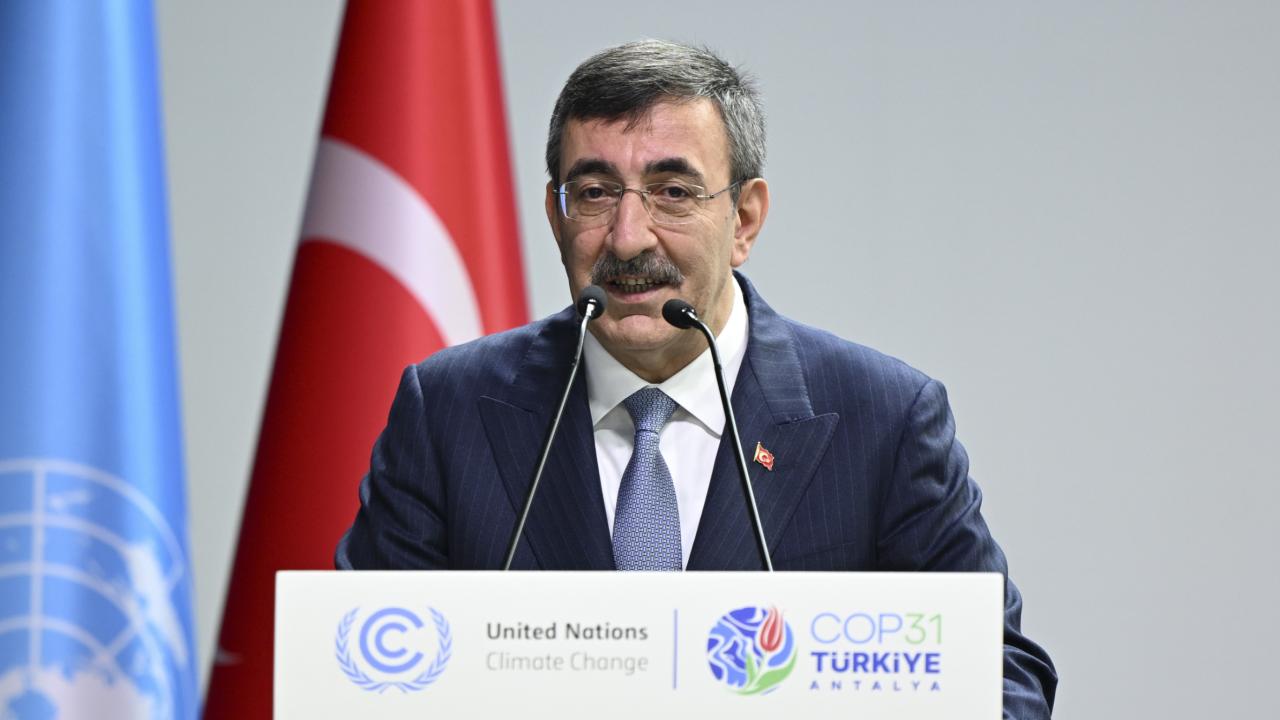
Vice President Cevdet Yılmaz delivered critical remarks during the session titled "The Second Decade of the Paris Agreement: Implementation and Finance," held at the Cappadocia Hall as part of the UN Climate Change Conference (COP31) in Antalya. Yılmaz stated that the first decade of the global climate struggle was spent establishing institutional foundations, but the second decade must be a period of transformation focused on concrete results, investments, and social welfare. Embodying Turkey's pioneering role in this process through the "Climate Implementation Bridge" (BRIDGE) initiative, Yılmaz expressed that climate goals and development priorities should not be mutually exclusive but rather structured to support one another.
Background of the Development
Since its adoption in 2015, the Paris Agreement has remained the world's most comprehensive consensus document aimed at limiting global warming to 1.5 degrees Celsius. The first decade was defined by countries preparing their Nationally Determined Contributions (NDCs), setting emission reduction targets, and building institutional capacity. However, scientific data indicates that current commitments are insufficient to achieve the projected emission reductions by 2035.
In this process, Turkey aims to maintain its development momentum as an emerging economy while placing green transformation at the center of its industrial policies. The COP31 platform is seen as a critical turning point for how these goals will be matched with international financial mechanisms. The high cost of financing faced by developing countries remains one of the biggest obstacles in the second decade of the Paris Agreement.
The BRIDGE initiative highlighted by Yılmaz serves as a bridge in this historical context, supporting countries in transforming their national plans into "investment-ready" projects. This is not merely an environmental policy but a reflection of Turkey's strategy to become a more active player in the global climate finance architecture.
Expert and Industry Insights
Experts in economics and environmental policy find Yılmaz's assertion that "finance is not just a matter of quantity" to be highly accurate. According to experts, the timely arrival of resources at appropriate costs is critical for the success of green transformation. Industry representatives' assessments are concentrated under the following points:
- "Project preparation capacity" is seen as the biggest bottleneck in accessing finance.
- Public resources must create a "leverage" effect to trigger private sector investments.
- Technology transfer is a variable as important as finance in the fight against climate change.
- "Just transition" mechanisms for developing countries are essential to prevent social unrest.
- Initiatives like LDC-GIF and SURFF are more likely to succeed when they focus on local needs.
Industry representatives state that Turkey's green industrialization move is inevitable to maintain competitiveness, especially in export-oriented sectors. The integration of climate investments with development goals, as pointed out by Yılmaz, directly aligns with Turkey's 2053 net-zero emission target.
Economic and Social Implications
Combating climate change means not only lowering emission levels but also creating new job opportunities and increasing economic resilience. Turkey's approach in this process views the cost of green transformation not as a burden, but as a long-term investment opportunity. In particular, energy efficiency and renewable energy investments have the potential to create positive effects on the current account deficit by reducing external dependency.
From a social perspective, climate-resilient cities (such as the SURFF initiative) directly affect the quality of life of citizens. The "improvements in people's lives" emphasized by Yılmaz prove that climate policies are not just a technical subject but a matter of social justice. Directing finance to the right channels will accelerate the transformation of local economies and minimize the risks of job losses.
Public-private sector cooperation stands out as the most rational model to share the financial burden of this transformation. The state's risk-mitigating policies will increase the appetite of private capital for green projects, ensuring that market liquidity shifts toward climate-friendly areas.
Future Projections and Outlook
In the coming period, it is expected that the decisions emerging from COP31 will be reflected in national legislations and that concrete fund flows will begin within the framework of the New Collective Quantified Goal (NCQG) on Climate Finance. While strengthening its own national capacity, Turkey also maintains its ambition to be a regional hub.
Risks include the potential for global geopolitical tensions to slow down financial flows and restrictions on access to technology. However, as Yılmaz stated, strengthening international partnerships and developing solutions tailored to local needs will play a key role in overcoming these risks.
In conclusion, Turkey's "Climate Implementation Bridge" vision is not just rhetoric but a strategic roadmap that will strengthen Turkey's hand in international climate diplomacy in the coming years. Success in the implementation phase will both consolidate Turkey's position in global climate leadership and allow its local industry to complete its green transformation.
💬 Yorumlar 0
Henüz yorum yapılmamış. İlk yorumu siz yazın!





