FM Fidan's Global Geopolitical Warning: 'Regional Ownership and Connectivity are Strategic Imperatives'
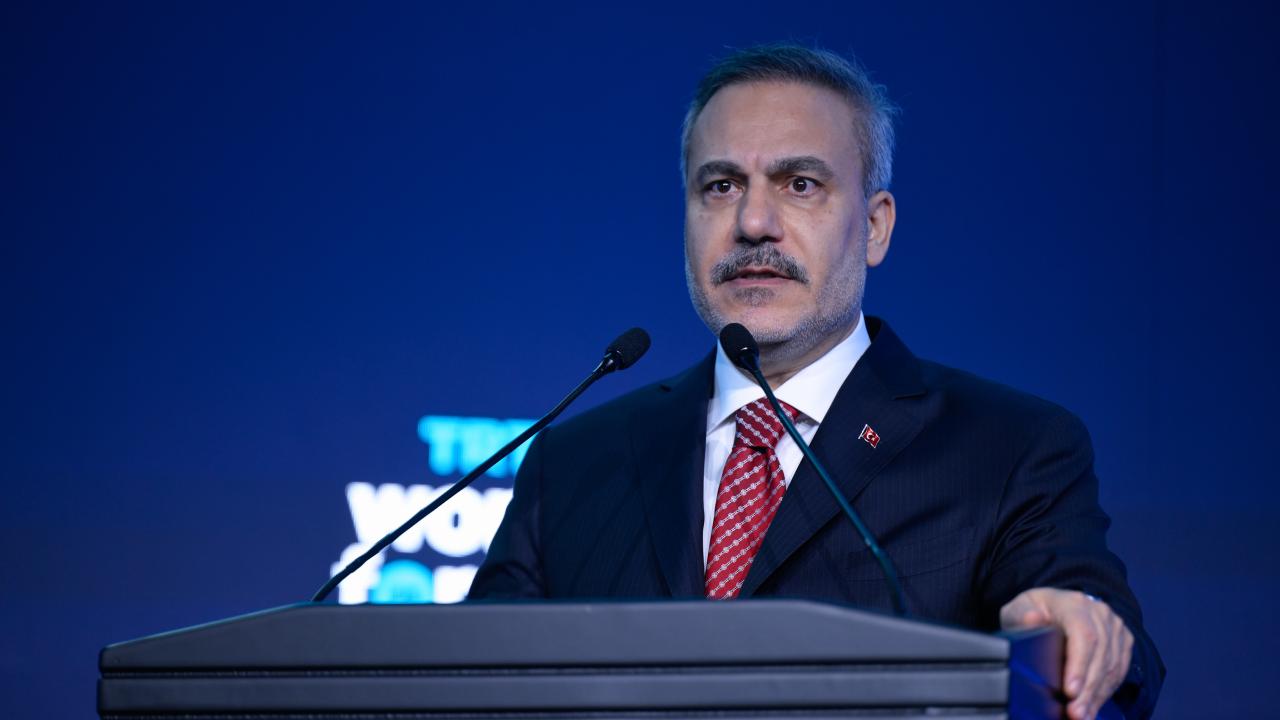
Foreign Minister Hakan Fidan delivered critical remarks at the TRT World Forum 2026, held at the Istanbul Congress Center under the theme "A World Without a Center: Who Leads When Rules No Longer Apply?" During the session titled "The New Geopolitics of Connectivity: Sea Lanes, Chokepoints, and Corridors," Fidan emphasized that the trade routes and energy pipelines that form the backbone of the global economy are facing increasingly severe security risks. Minister Fidan highlighted the devastating impact of Israel's expansionist policies and the ongoing humanitarian crisis in Gaza on global stability, urging the international community to address the root causes of these issues.
Fidan pointed out that the concept of "connectivity" has become a source of strategic anxiety. Warning that global supply chains could be paralyzed by a single chokepoint, the Minister stated that the use of energy pipelines and sea lanes as tools of political pressure is unacceptable. Asserting that Turkey views its geographical position not merely as a bridge but as a sphere of strategic responsibility, Fidan argued that maintaining regional ownership is the key to global prosperity.
Background of the Development
In a world where approximately 80 percent of global trade is conducted by sea, critical transit points such as the Suez Canal, the Strait of Malacca, and the Black Sea have become the epicenter of geopolitical competition. Historically, these routes were symbols of economic cooperation, but today they stand out as the most vulnerable points in the power struggle between states. Especially in the post-pandemic era, disruptions in supply chains have accelerated the search for "strategic autonomy" among nations.
Turkey, situated at the heart of the historic Silk Road and now a key player in global logistics networks through projects like the Middle Corridor, is at the center of these debates. The concept of "regional ownership" emphasized by Minister Fidan represents the will of regional countries to determine their own destiny and build a resilient structure against external interference. Conflicts in the Black Sea and instability in the Middle East have proven that the security of these routes is not just an economic matter, but a national security issue.
From an institutional perspective, platforms like the TRT World Forum serve as vital diplomatic channels through which Turkey conveys its vision of "a fairer world" to the global public. Fidan's speech reinforces Turkey's claim to be not just a transit country, but a rule-maker and mediator in resolving global crises.
Expert and Industry Insights
Industry representatives and geopolitical analysts state that Minister Fidan's call to "diversify connectivity" is of vital importance for the future of global trade. According to experts, dependence on a single route makes supply chain security impossible. Industry evaluations are summarized under the following points:
- The Necessity of Diversification: Relying on a single chokepoint leaves the global economy at risk of collapse from a single geopolitical shock.
- Balance of Security and Economy: Economic security cannot be separated from military security; multilateral security architectures are essential for the protection of sea lanes.
- Infrastructure Investments: Turkey's projects, such as the Middle Corridor, serve not only as logistics but also as a geopolitical insurance policy.
- Diplomatic Mediation: Against the use of energy pipelines as tools of political pressure, Turkey's "balance policy" and "mediation" strategy serve as a model for global energy security.
- Institutional Resilience: Global institutions need to develop more proactive and binding rules regarding the management of chokepoints.
Experts interpret Fidan's warning that "connectivity should not be reduced to zero" as a call for a transition to a "safer and more inclusive globalization" model rather than a total rejection of globalization.
Economic and Social Implications
Minister Fidan's messages concern not only state-to-state relations but also household economies directly. A disruption in supply chains triggers inflation in countries thousands of kilometers away and makes access to basic food and energy difficult. Turkey's emphasis on regional ownership is evaluated as a "protective shield" aimed at reducing the impact of these economic shocks.
From a social perspective, migration waves and humanitarian crises caused by regional instabilities are the most painful consequences of disrupted connectivity. Fidan's emphasis on Gaza serves as a reminder that economic security cannot be separated from human security, and that conflicts in the region are not just local but global prosperity issues. Turkey's vision is seen as an effort to build a "culture of cooperation" among regional actors.
Future Projections and Outlook
In the coming period, Turkey is expected to lead more logistics and energy projects in line with its vision of "diversifying connectivity." Specifically, increasing the capacity of the Middle Corridor and strengthening the security architecture in the Black Sea will remain at the top of Ankara's foreign policy agenda.
In official processes, it is likely that Turkey will initiate a new move regarding the "management of chokepoints" within international organizations. This process will be based on a broad strategic framework that includes not only physical infrastructure but also digital and financial connectivity. The risks include the potential for the expansion of conflicts in the region and the intensification of competition between global powers.
In conclusion, the framework drawn by Minister Fidan clearly demonstrates Turkey's goal of being an "island of stability" in a world full of uncertainties by combining its geographical advantage with vision, infrastructure, and diplomacy. In the coming years, Turkey aims to be not just a transit point but a rule-making center in the restructuring of global supply chains.
💬 Yorumlar 0
Henüz yorum yapılmamış. İlk yorumu siz yazın!





