Minister Kurum Launches 'Implementation COP' Era at COP31: A New Roadmap for Green Transition
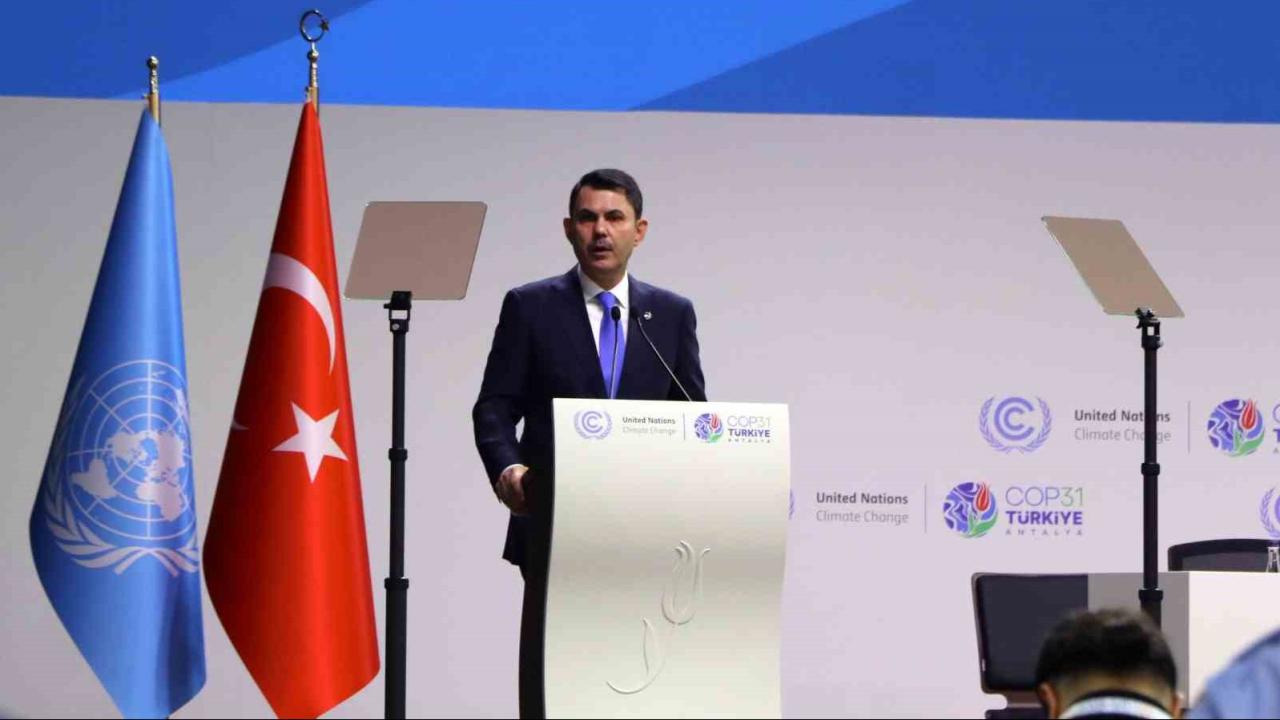
Environment, Urbanization and Climate Change Minister and COP31 President Murat Kurum made critical statements regarding global climate diplomacy at the opening program of the Union of Chambers and Commodity Exchanges of Turkey (TOBB) Business Forum. Defining the COP31 process as an 'Implementation COP,' Minister Kurum emphasized that the time for mere commitments on paper has passed. Kurum stated that they aim to place Turkey's and the world's climate goals on a concrete, measurable, and achievable foundation with a 10-point Action Agenda.
The roadmap announced by Minister Kurum covers a wide spectrum, including clean energy, circular economy, methane reduction, and resilient cities. In particular, the targets to increase the share of electricity in final energy consumption to 35 percent and the use of circular materials in production and manufacturing to at least 15 percent by 2035 signal a radical shift in Turkey's industrial and production strategy. The establishment of a 'Climate Implementation Bridge' stands out as a strategic step aimed at bringing project owners together with finance and technology.
Background of the Development
The fight against climate change has become the main agenda item of global politics and economics in recent years. The process, which began with the Paris Climate Agreement, has gained a more technical and binding structure through COP summits. However, the feasibility of decisions taken at previous summits and the inadequacy of financial mechanisms have created a 'gap in implementation' on a global scale. This new era, led by COP31 President Murat Kurum, is considered a paradigm shift aimed at closing this gap.
Turkey is currently focusing on its 2053 net-zero emission target in line with its 'Green Development Revolution' vision. This goal is not only an environmental necessity but also an economic requirement for Turkey to maintain its global competitiveness. Naming COP31 as the 'Implementation COP' reinforces Turkey's leading role in this process while demonstrating its determination to come to the table with concrete projects in international platforms.
Historically, climate summits have been viewed as spaces for negotiation between heads of state and diplomats. However, the partnership Minister Kurum has established with TOBB proves that this process has now become the main agenda of the private sector, the business world, and financial institutions. The 10 headings in the Action Agenda are designed not just as environmental policy, but as an industrial and investment strategy.
Expert and Industry Insights
Economy and environmental experts describe the targets announced by Minister Kurum as 'realistic and visionary.' Industry representatives state that the steps to be taken, especially regarding access to finance and technology transfer, will determine the speed of Turkey's green transition. According to experts, the key elements to consider in this process are as follows:
- Modernization of grid infrastructure is critical for the transition to clean energy.
- Circular economy models will provide a competitive advantage by reducing raw material costs.
- Diversification of green finance instruments will facilitate the adaptation of SMEs to the transition.
- Specific targets such as methane reduction will give birth to new business models in agriculture and waste management sectors.
- Integration of digitalization and green technologies will be the key to productivity growth.
Industry representatives emphasize that the cooperation carried out with TOBB is vital for bringing the voice of the private sector to international climate negotiations. Aligning the investment power of the business world with climate goals will strengthen Turkey's position in export markets while reducing its carbon footprint.
Economic and Social Implications
The fight against climate change is not just an environmental issue, but also a major economic transformation process. As Minister Kurum stated, companies that invest in clean technology and energy efficiency will be the winners of the next decade. This transformation necessitates the modernization of traditional sectors with more sustainable methods while creating new employment areas.
At the social level, topics such as resilient cities and food security will directly affect the quality of life of citizens. Strengthening cities against the natural disaster risks brought by climate change is of critical importance for protecting social welfare. Furthermore, involving the younger generations in this transformation process forms the basis of a social consensus for a sustainable future.
Future Projections and Outlook
In the coming period, it is expected that the COP31 Action Agenda will be detailed and concrete projects will be implemented. Investments to be made through the 'Climate Implementation Bridge' will increase Turkey's share in green finance markets. It is anticipated that public-private sector cooperation will continue uninterruptedly to reach the 2035 targets and that legislative regulations will be harmonized with these goals.
Risks include global economic fluctuations and disruptions in technology supply chains. However, Turkey's production capacity and innovative approach have the flexibility to manage these risks. This process, led by Minister Kurum, demonstrates Turkey's determination to become not only a regional but also a global climate leader.
💬 Yorumlar 0
Henüz yorum yapılmamış. İlk yorumu siz yazın!





