Minister Kurum: Safe and Resilient Cities Are the Right of Every Society
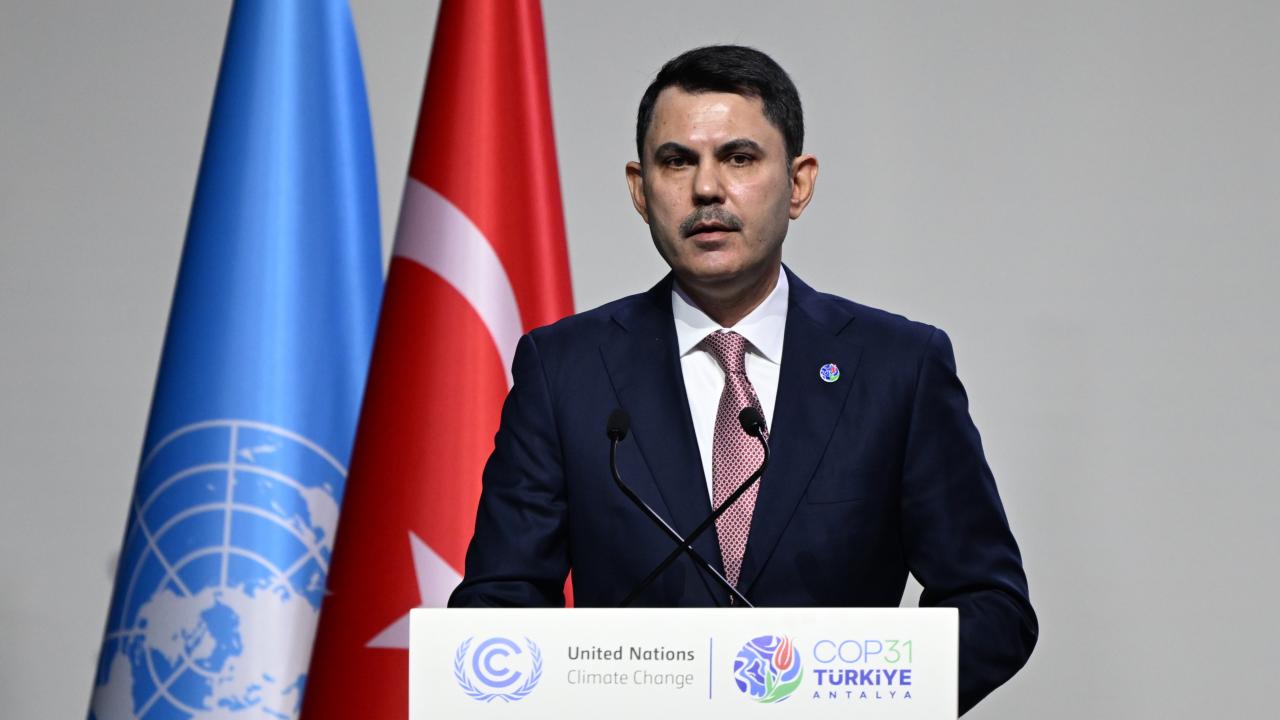
Minister of Environment, Urbanization and Climate Change Murat Kurum delivered critical remarks at the "Urban Resilience, Climate Adaptation, and Climate Action Leaders Event" held at the Mediterranean Hall in the COP31 area. Minister Kurum stated that floods, droughts, and extreme temperatures are not merely environmental issues but structural crises that directly threaten housing, production, and public health. Emphasizing that the true strength of a city is measured by how safe its people feel, Kurum stated that climate adaptation is no longer a choice but a mandatory paradigm that must be at the center of development policies.
Minister Kurum emphasized that the primary goal of the COP31 Presidency is to transform the common will expressed on a global scale into tangible results with real-world impact. Arguing that commitments must be met with projects and investments must be translated into improvements in human life, Kurum stressed that central and local governments must walk in the same direction during this process. He stated that building resilient cities is possible not only with reinforced concrete structures but with a holistic approach that protects nature, strengthens infrastructure, and guarantees the continuity of basic services.
Background of the Development
Stating that Turkey experienced the meaning of this responsibility in the harshest way possible with the Kahramanmaraş-centered earthquakes on February 6, 2023, Minister Kurum recalled that a geography of approximately 110,000 square kilometers, where 14 million citizens lived across 11 provinces, was deeply shaken. To emphasize the scale of the region, he stated that it is comparable to Bulgaria and Iceland in terms of surface area, and equivalent to approximately five times the population of Lithuania. This picture reveals the scale of the disaster Turkey faced.
The "construction mobilization of the century," initiated under the leadership of President Recep Tayyip Erdoğan, serves as a global case study on how the post-disaster recovery process should be managed. Minister Kurum stated that 455,000 houses, village houses, and workplaces were completed and delivered to their rightful owners in just two years. This process went down in history as a massive urban transformation operation that included not only housing construction but also the restoration of roads, infrastructure, squares, and bazaars.
The care taken to preserve the historical texture, neighborhood culture, and the memory of the cities formed the cornerstones of Turkey's vision for post-disaster reconstruction. This approach, which does not consider disaster risk, energy efficiency, water management, and public services separately, was combined with the principle of "safe housing and strong infrastructure." The fact that all the homes built are equipped with energy-efficient, zero-waste compatible, and climate-friendly materials proves Turkey's determination regarding sustainable urbanization to the world.
Expert and Industry Insights
Urban planners and climate economists state that the vision of "resilient cities" emphasized by Minister Kurum will be one of the most important investment items of the global economy in the coming decades. According to experts, cities that adapt to climate change offer higher economic efficiency in the long run by minimizing post-disaster costs. Industry representatives state that Turkey's rapid recovery process in the earthquake zone is a success that will enter world literature in terms of "structural resilience" and "rapid response" capacity.
- Climate change adaptation must become an integral part of urban planning.
- Energy efficiency and zero-waste principles should become standard in new housing projects.
- Full coordination must be ensured between central and local governments regarding disaster management.
- Preserving historical and cultural texture is critical for the sustainability of urban identity.
- Infrastructure investments must be modernized to be resistant to extreme weather events.
Industry representatives also emphasize that the "resilient meetings" initiated in Hatay are an important model in terms of the participation of local stakeholders in the process. This roadmap, extending from post-disaster recovery to permanent transformation, is evaluated not only as a physical construction but also as a social healing process.
Economic and Social Implications
Although the economic cost of building resilient cities is high, the cost of destruction that may occur after a disaster is much greater. Turkey's investments in this field encourage the use of new technologies in the construction sector while accelerating the transition to a "green economy." From a social perspective, the right to live in safe housing stands out as one of the most fundamental elements that strengthen citizens' trust in the state.
As Minister Kurum stated, the planning approach that "meets today's needs and takes into account tomorrow's risks" forms the basis of social peace and economic stability. Revitalizing social life, especially in the earthquake zone, is of critical importance for the recovery of the regional economy. Building commercial areas, squares, and social facilities simultaneously with housing ensures that cities are not just sleeping areas but living centers.
Future Projections and Outlook
In the coming period, Turkey's goal is to share this experience within a broader framework on international platforms and to guide other countries fighting climate change. The ground provided by COP31 offers an important opportunity for Turkey to make its "climate-friendly urbanization" vision a global standard.
In the official process, it is expected that legal regulations and incentives for creating cities resilient to disaster risks will be increased. In particular, the widespread use of energy-efficient buildings will play a key role in Turkey's achievement of its carbon-neutral goals. Making risk management and early warning systems an integral part of urban planning forms the basis of the goal of leaving a safer living space for future generations.
In conclusion, as Minister Kurum expressed, "safe and resilient cities are the right of every society." With the steps it has taken to establish this right, Turkey is moving confidently toward becoming a global reference point for disaster management and urban transformation.
💬 Yorumlar 0
Henüz yorum yapılmamış. İlk yorumu siz yazın!





