Minister Tekin Emphasizes Education at COP31: A New Generation Vision for Climate Action
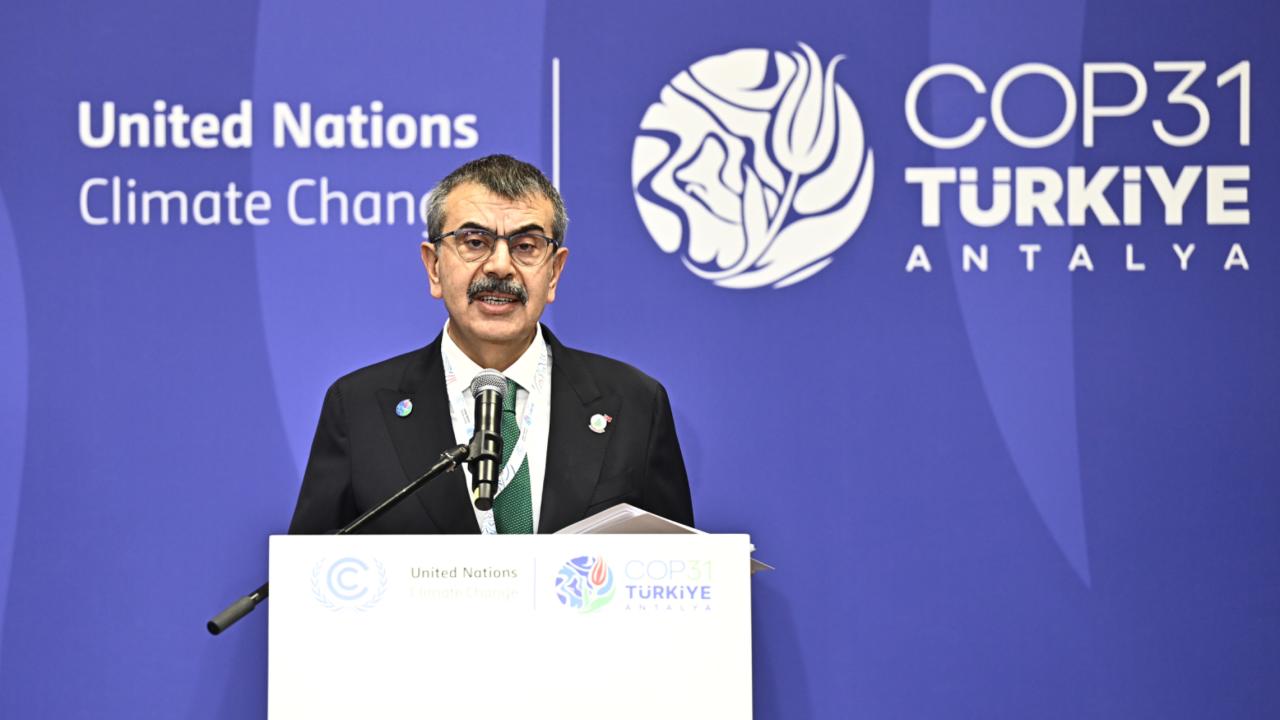
Minister of National Education Yusuf Tekin presented a critical perspective on the global climate crisis at the High-Level Ministerial Opening Session, held in collaboration with UNESCO, during the United Nations (UN) Climate Change Conference (COP31) in Antalya. Minister Tekin stated that humanity's misconception of nature as a controllable resource rather than an independent order has turned environmental destruction into a chronic habit, asserting that this trend can only be reversed through a fundamental shift in mindset driven by education systems.
Pointing out that while machines are becoming more energy-efficient, total human consumption continues to rise, Tekin argued that legal regulations and international commitments are not enough on their own. "I believe that laws alone cannot change a perspective so deeply embedded in minds, and that we can only transform it in the minds and hearts of a new generation," the Minister said, emphasizing the strategic role of education in this process.
Background of the Development
Climate change has become the most significant agenda item in global diplomacy in recent years. The COP series of conferences aims to coordinate the steps taken by states to reduce carbon emissions and achieve sustainable development goals. In this process, Turkey has entered a comprehensive transformation period not only in the industrial and energy sectors but also in its educational policies.
Historically, environmental education was often treated as a sub-topic of science courses. However, today, climate change has become a multidisciplinary issue with ethical, social, and economic dimensions. Following the UN General Assembly's recognition of a clean and healthy environment as a human right and the Committee on the Rights of the Child's reminder of states' obligations to protect children's rights against climate change, Turkey has accelerated its efforts to align its national legislation and educational curriculum with these universal standards.
The 'Century of Turkey Education Model' highlighted by Minister Tekin emerges as the most concrete output of this background. The model adopts an approach that does not separate knowledge from values or skills from character, aiming to move environmental sustainability beyond being just a course content and into a way of life.
Expert and Industry Insights
Educational scientists and environmental experts are responding very positively to Minister Tekin's emphasis on curriculum reform. According to experts, climate literacy should not be just a transfer of theoretical knowledge but a process focused on behavioral change. Industry representatives state that these contents, integrated into 19 different courses from preschool to secondary education, will directly affect Turkey's environmental footprint in the long run.
- Making climate change education a mandatory part of the curriculum will increase the level of social awareness.
- Implementing sustainable living practices (waste management, energy saving) in schools ensures that theoretical knowledge turns into behavior.
- Structuring the education system around values contributes to raising generations who see nature not as a resource, but as a trust.
- International collaborations are increasing Turkey's global visibility in the fight against climate change.
- Specialized training for teachers on this subject is a critical threshold for the success of the curriculum.
Experts emphasize that at the point where knowledge meets values, students will not only learn the causes of climate change but also become active subjects in solving these problems.
Economic and Social Implications
This education-focused strategy is not only an environmental gain but also an economic necessity. The transition to a green economy requires a workforce with high environmental awareness that uses resources efficiently. As Minister Tekin stated, protecting the right of future generations to live is the most fundamental responsibility of today's education system.
At the social level, it is expected that environmental awareness will spread to families and local communities. Bringing sustainable living habits acquired in schools into homes can lead to micro-level economic improvements in areas such as energy and water conservation. This will contribute to increasing the efficiency of public spending while also reducing health costs caused by environmental pollution in the long term.
Stakeholders state that this vision of Turkey also strengthens the image of a 'society ready for green transformation' in the eyes of international investors. Education is seen as the most sustainable and permanent tool for this transformation.
Future Projections and Outlook
In the coming period, this climate-focused transformation in Turkey's education curriculum is expected to serve as a model for other countries. As Minister Tekin pointed out, the process of turning the knowledge gained from the curriculum into behavior requires the physical infrastructure of schools to be transformed in line with this vision.
In the official process, with the updating of the curriculum and the completion of teacher training, it is aimed that students will graduate better equipped regarding climate change. Risks include how quickly the curriculum can adapt to rapidly changing technological and environmental conditions. However, the flexibility of a value-oriented model allows these risks to be minimized.
In conclusion, these steps taken by Turkey in education aim to build a generation that will guide climate policies not only for today but for the next century. This determination expressed on the COP31 platform clearly demonstrates Turkey's ambition in its vision for a sustainable future.
💬 Yorumlar 0
Henüz yorum yapılmamış. İlk yorumu siz yazın!