MIT Chief Kalin: The Problem is Not Palestine, It is the Occupation
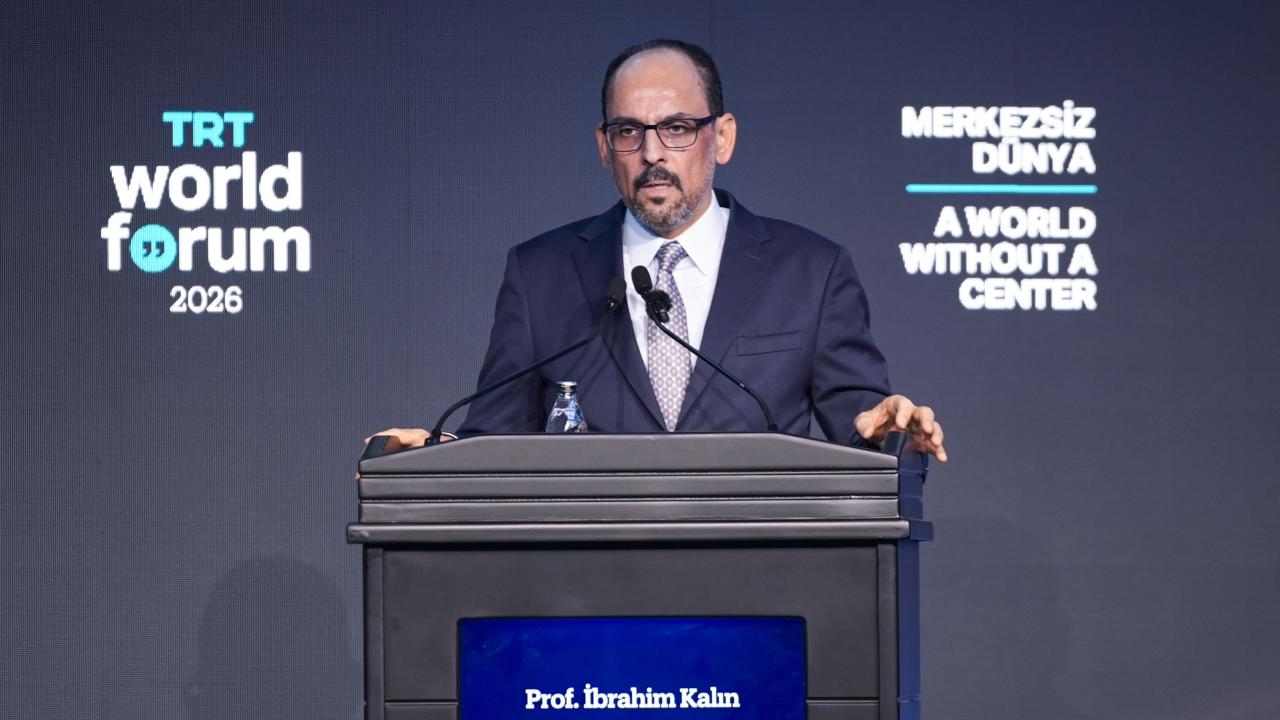
The head of the National Intelligence Organization (MIT), Ibrahim Kalin, addressed the chaotic state of the global order and the humanitarian crisis in Gaza with a profound perspective during the TRT World Forum 2026, held at the Istanbul Congress Center. Speaking before the panel titled "Gaza at the Intersection of International Law and Humanitarian Collapse," held under the theme "A Decentralized World: Who Leads When Rules No Longer Apply?", Kalin drew attention to the dangerous process into which the disconnect between politics and morality is dragging the world. Kalin stated that Gaza is not just a region, but the epicenter of a global struggle for justice and dignity, revealing that the current world order is facing a structural crisis.
Kalin's remarks revealed that politics becomes blind when devoid of morality, and morality becomes powerless when devoid of authority, defining the tragedy in Gaza as a result of the bankruptcy of these two concepts. According to him, Gaza is not only a part of the Palestinians' honorable struggle but also a litmus test for global values and universal principles. In this context, the fact that the problem is not the existence of Palestinians, but the systematic occupation of their lands, serves as a critical call for the reawakening of the global conscience.
Background of the Development
The reality of "occupation" emphasized by Ibrahim Kalin is rooted in the historical origins of instability in the Middle East. The occupation processes that have continued since the mid-20th century, combined with the passivity of the international community and the injustice of the established order, have paved the way for today's humanitarian collapse. Historically, the Palestinian issue has been labeled as a "problem," but this labeling has targeted the victim rather than the source of the problem. This approach is the product of a distorted diplomatic language that allows the occupying power to maintain its legitimacy while keeping the victim in a constant defensive position.
The security architecture built by the Western-centric world order through institutions established after World War II is incapable of protecting its own principles, as seen in the case of Gaza today. The process that Kalin describes as the "search for a multi-centered world order" is actually an admission that the current system has lost its legitimacy. The dysfunctionality of global governance mechanisms has led to international law becoming an instrument that serves only the interests of the powerful. This situation shows that institutions are focused on maintaining the status quo rather than protecting universal values.
The situation in Gaza is not just a regional conflict but a bankruptcy of global moral responsibility. The erosion of institutions, treaties, and universally accepted moral principles creates a security gap that threatens not only the people of the region but the entire world order. The continuation of the occupation destroys not only Palestinian lands but also the fundamental pillars of the international system. This historical process proves that no state can have long-term security guarantees in an order where justice is not served.
Expert and Industry Insights
International relations experts and geopolitical analysts evaluate Kalin's "the problem is not Palestine, but the occupation" approach as a paradigm shift for the Middle East peace process. Industry representatives argue that this discourse should redefine diplomatic terminology. Experts highlight the following key points for the resolution of the current crisis:
- Ending the occupation is essential for the restoration of international law norms.
- A multi-centered security architecture is necessary to overcome the global governance crisis.
- Moral responsibility must become the fundamental basis of political authority.
- The humanitarian crisis in Gaza is a legitimacy test for the global system.
- Ending the occupation is the only key to lasting peace in the Middle East.
Experts state that in the new world order, which Kalin describes as "chaotic and unpredictable," states must create their own moral compasses. This is not just a struggle for military or economic power, but also a war of values. From a technical standpoint, it seems impossible for existing international institutions (such as the UN) to solve this crisis without reform. In this period where power balances are shifting, the existence of institutions that cannot take a moral stance makes global stability even more fragile.
Economic and Social Implications
The continuation of the occupation and the uncertainty of the global order lead to serious economic and social repercussions, not just political ones. In a world dominated by uncertainty, the investment climate deteriorates and social unrest increases. The fact that the drama in Gaza is spread to the whole world instantly through social media and digital platforms mobilizes the conscience of societies while creating serious pressure on governments. This situation shows that global public opinion has reached a power that can directly influence the foreign policy decisions of states.
Economically, instability in the Middle East directly affects energy supply security and trade routes. However, as Kalin emphasized, the issue is too deep to be explained only by economic data. At the social level, the search for "justice and dignity" creates a wave of global solidarity. This situation forces states to take public pressure into account more when determining their foreign policies. The fact that economic prosperity is more sustainable in an environment where justice is provided reveals that the cost of the occupation is not limited to Palestine.
Future Projections and Outlook
In the coming period, it seems inevitable that the international community will face the reality of the "occupation." As Kalin pointed out, it is a necessity to place moral and humanitarian principles at the center while building a new world order. Otherwise, the current chaotic structure will deepen further, and the chain of unpredictable crises will continue. In official processes, taking concrete steps to end the occupation is of critical importance not only for the Middle East but also for the establishment of global peace.
Expectations are that international actors will abandon the "Palestinian problem" terminology and focus on the goal of "ending the occupation." Although this is a long-term process, it is the first step that must be taken for the establishment of justice. The international community's acceptance of the occupation as a security problem rather than protecting the status quo will be the key to the solution. Otherwise, the loss of legitimacy of the current system will continue to deepen.
In conclusion, MIT Chief Ibrahim Kalin's visionary approach at the TRT World Forum aims to add moral depth to global politics. Future projections can only reach a safe harbor in a world order where the occupation has ended and equality, dignity, and justice are provided for everyone. This process is not just a diplomatic effort, but also a test of humanity's common conscience.
💬 Yorumlar 0
Henüz yorum yapılmamış. İlk yorumu siz yazın!





