President Erdoğan's Intensive Diplomacy at COP31: Emphasis on Regional Stability
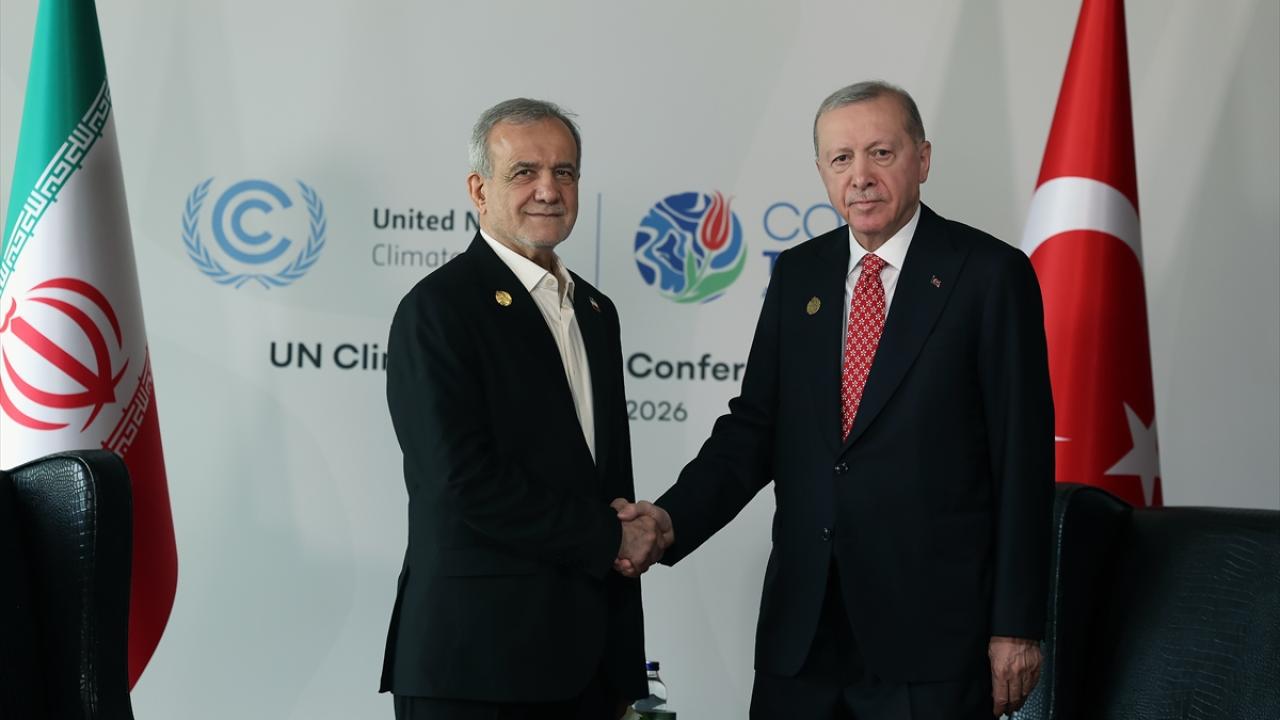
President Recep Tayyip Erdoğan is conducting an intensive diplomatic schedule during his attendance at the 31st Conference of the Parties (COP31) to the United Nations Framework Convention on Climate Change. Meeting with Iranian President Masoud Pezeshkian on the sidelines of the summit, Erdoğan emphasized the urgent need for diplomacy to establish regional stability. The meeting was attended by a high-level Turkish delegation, including Foreign Minister Hakan Fidan, Minister of National Defense Yaşar Güler, AK Party Spokesperson Ömer Çelik, MIT Chief İbrahim Kalın, and Presidential Communications Director Fahrettin Altun.
The core of the Erdoğan-Pezeshkian meeting was the cessation of tensions between Iran and the U.S. and the construction of lasting peace. President Erdoğan stated that the establishment of a negotiation table is now a necessity, reiterating Turkey's determination to pursue peace-oriented solutions. Furthermore, in his meeting with Democratic Republic of the Congo President Felix Antoine Tshisekedi, Erdoğan exchanged views on strengthening bilateral relations and global cooperation.
Background of the Development
The COP31 Summit serves as a critical ground for mitigating global geopolitical tensions, extending beyond its primary role as a platform for combating climate change. Turkey stands out with its role as a 'mediator' and 'facilitator,' particularly in conflict zones in the Middle East. The historical neighborly relations with Iran strengthen Turkey's position as a balancing factor in the region.
The tension along the Iran-U.S. axis has long threatened global energy markets and regional security. President Erdoğan's call at this summit demonstrates that Turkey is following a strategy consistent with its 'regional ownership' doctrine. Diplomatic channels previously maintained with Tehran are being restructured today with a broader vision of regional peace.
The meeting with the Democratic Republic of the Congo is a continuation of Turkey's 'Africa Outreach' policy. As Turkey increases its economic and diplomatic presence across the continent, the contacts established with President Tshisekedi aim to integrate energy and infrastructure cooperation with climate change mitigation goals.
Expert and Industry Insights
International relations experts define Erdoğan's contacts at COP31 as 'crisis management diplomacy.' According to experts, Turkey's capacity to engage with both sides plays a key role in de-escalating regional tensions. Industry representatives highlight the economic implications of this diplomatic traffic.
- The cessation of regional conflicts will directly and positively impact energy supply security.
- Diplomatic solution-seeking efforts have the potential to lower regional investment risk premiums.
- Turkey's mediation role strengthens Ankara's hand in global power balances.
- Climate change and energy transition may create new areas of cooperation along the Turkey-Iran-Congo axis.
- The establishment of a negotiation table is seen as a prerequisite for the stability of global supply chains.
Economists argue that uncertainty in conflict zones exerts pressure on global inflation; therefore, Erdoğan's call for peace is not only a political but also an economic necessity. Turkey's 'solution-oriented' approach during this process is evaluated as a confidence-building factor in international markets.
Economic and Social Implications
Regional stability has a direct impact on Turkey's foreign trade volume and energy costs. A potential normalization process with Iran could revitalize cross-border trade and allow for more efficient use of energy pipelines. Socially, the end of regional conflicts means controlling migration flows and preventing humanitarian crises.
The ties established with the Democratic Republic of the Congo reinforce Turkey's soft power in Africa. Technology transfers and agricultural cooperation within the scope of combating climate change will contribute to the social development goals of both nations. Turkey's multi-dimensional foreign policy supports its image as a 'constructive power' in both local and international public opinion.
Future Projections and Outlook
In the coming period, Turkey's mediation activities are expected to yield concrete results. Opening a 'diplomacy channel' specifically on the Iran-U.S. axis could create a wave of relief in global markets. Ankara will increase its diplomatic pressure to bring the parties to the negotiation table during this process.
The outcomes of the COP31 Summit will also be consistent with Turkey's 'Green Development Revolution' goals. Combating climate change is being addressed not only as an environmental issue but also as an economic transformation process. Turkey aims to be both a guarantor of regional peace and a pioneer of sustainable development in this process.
In conclusion, President Erdoğan's contacts at COP31 have once again registered Turkey's weight in global politics. In the coming months, it is likely that we will see the fruits of these meetings in terms of both regional security and bilateral economic relations.
💬 Yorumlar 0
Henüz yorum yapılmamış. İlk yorumu siz yazın!





