TRT World Forum 2026: Seeking Reconstruction and Economic Recovery Amidst Global Crises
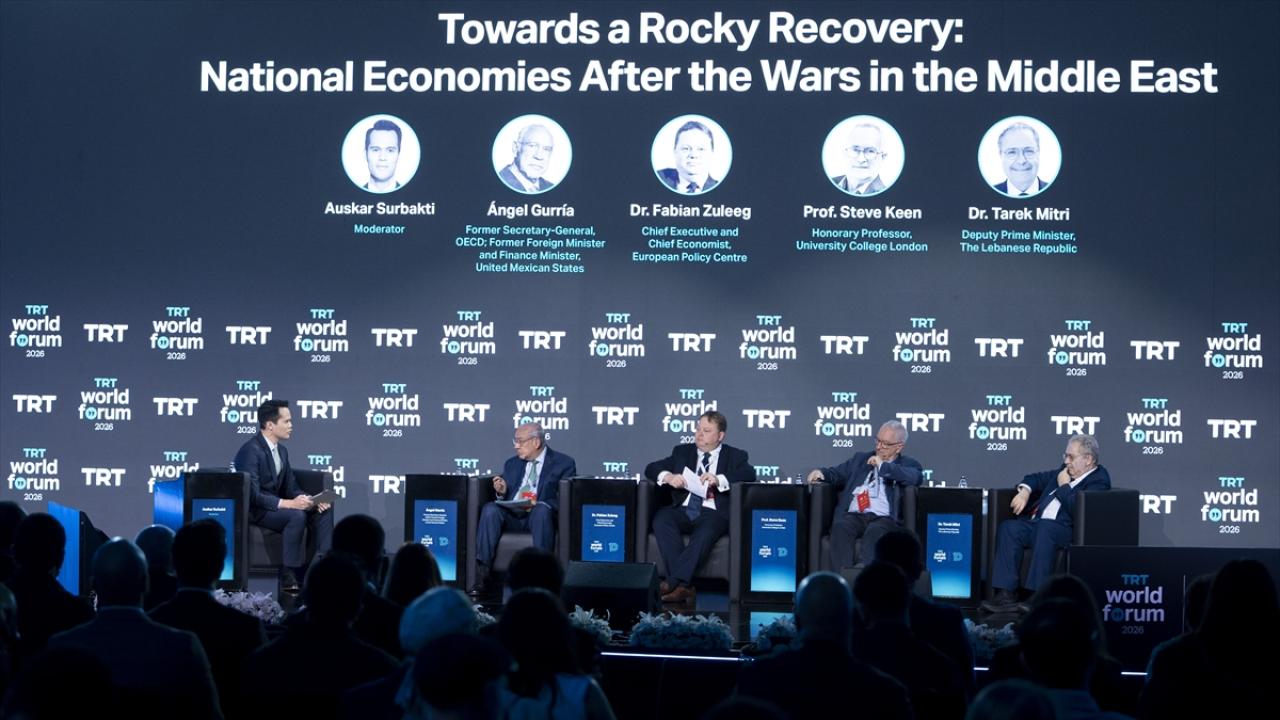
The Istanbul Congress Center hosted the 10th edition of the TRT World Forum 2026, a pivotal event that keeps the pulse of global politics. Under the theme 'Decentralized World: Who Leads When Rules No Longer Apply?', the forum scrutinized the bottlenecks of the international system and the economic crises deepened by ongoing conflicts. The session titled 'Towards a Painful Recovery: Post-War National Economies in the Middle East' particularly drew attention with striking data revealing the economic dimensions of the humanitarian tragedy in the region.
Moderated by Auskar Surbakti, the panel brought together prominent experts including former OECD Secretary-General Angel Gurria, European Policy Centre Chief Executive and Chief Economist Fabian Zuleeg, University College London honorary professor Steve Keen, and Lebanese Deputy Prime Minister Tarek Mitri. The session served not only as a platform for theoretical discussion but also as a ground where concrete financial roadmaps for rebuilding war-torn geographies were debated.
Background of the Development
The Middle East has entered an unprecedented spiral of geopolitical instability in recent years. The destruction spanning from Lebanon to Gaza, and from Syria to other conflict zones in the region, is characterized not only by the loss of life but also by an economic collapse that will last for generations. As emphasized by Lebanese Deputy Prime Minister Tarek Mitri, Israel's occupation policies and attacks have demolished the country's basic infrastructure, rendered villages uninhabitable, and displaced millions of people.
Historically, post-war reconstruction processes have been among the most challenging endeavors testing the collective will of the international community. While examples like the Marshall Plan after World War II demonstrate how large-scale economic aid can revive a nation, achieving such coordination in today's 'decentralized' world has become significantly more complex. Current conflicts in the region are destroying not just physical infrastructure but also the social fabric and economic confidence, making reconstruction a much costlier and long-term process.
In this context, TRT World Forum 2026 holds critical importance for reminding us that conflicts are not merely military issues but a 'development debt' that must be addressed for the sustainability of the global economy. While it seems impossible for countries in the region to shoulder these costs on their own, the role of international financial institutions and regional actors has evolved into a more vital position than ever before.
Expert and Industry Insights
Experts on the panel stated that the reconstruction process is not just about concrete and steel, but also requires institutional reforms and political stability. Former OECD Secretary-General Angel Gurria summarized the gravity of the situation with the figures he presented: a funding requirement of approximately $20 billion for Lebanon, at least $75 billion for Gaza, and three times that amount for Syria is a scale that would challenge the capacity of the global financial system.
- The financial burden must be shared among multilateral development banks and national governments.
- Reconstruction is not just the repair of physical structures but the restructuring of the economic system.
- Regional cooperation is the fundamental element that will increase the effectiveness of external aid.
- The balance between humanitarian aid and development assistance must be maintained for sustainable recovery.
- Economic investments made without ensuring political stability remain vulnerable to the risk of conflict.
Economists like Steve Keen and Fabian Zuleeg emphasized that this process is not just a matter of 'donations' but an 'investment' to revitalize global supply chains and regional trade. According to the experts, investments in conflict zones serve as a 'security insurance' that could prevent problems like global inflation and migration waves.
Economic and Social Implications
The economic effects of conflicts are not limited to the geographies where the war takes place; they spread over a wide area from neighboring countries to global markets. The social pressure created by millions of displaced people places a serious burden on the public services of host countries, which also brings about a long-term demographic crisis. As Tarek Mitri stated, for people to return to their homes, not only houses but also schools, hospitals, and workplaces must be rebuilt.
For market actors, the uncertainty in the Middle East is one of the biggest factors deterring foreign direct investment (FDI) in the region. If the reconstruction process is not carried out within the framework of transparency and accountability, it may face risks such as corruption and waste of resources. Therefore, it is stated that the international community should not only transfer money but also establish oversight mechanisms.
At the social level, the psychological destruction caused by war is one of the biggest obstacles to economic recovery. In an environment where people do not trust the future, it is very difficult for economic development moves to succeed. Therefore, designing reconstruction projects with an approach that centers on social participation will ensure that the people of the region feel a sense of belonging to the process.
Future Projections and Outlook
In the coming period, post-conflict reconstruction processes are expected to be at the top of the international agenda. Combining the financial power of Gulf countries with the technological and institutional accumulation of Western nations will play a key role in meeting these massive costs. However, this process requires not only financial transfer but also long-term diplomatic consensus.
Among the risks, the reignition of conflicts or the escalation of regional tensions could derail all reconstruction plans. Therefore, it is of critical importance that economic aid proceeds in parallel with political resolution processes and that the principle of 'peace first, development second' is implemented. International organizations are expected to take a more proactive role in this process and work in closer coordination with local governments.
In conclusion, TRT World Forum 2026 has once again proven that conflicts are not just headlines, but economic and social wounds that threaten the common future of humanity. The reconstruction process means repairing not only destroyed buildings but also shattered hopes. We have entered a period where global leadership and solidarity will be tested on this challenging journey.
💬 Yorumlar 0
Henüz yorum yapılmamış. İlk yorumu siz yazın!





