Minister Şimşek: Competition Among Regional Actors Will Decrease, Cooperation Will Increase
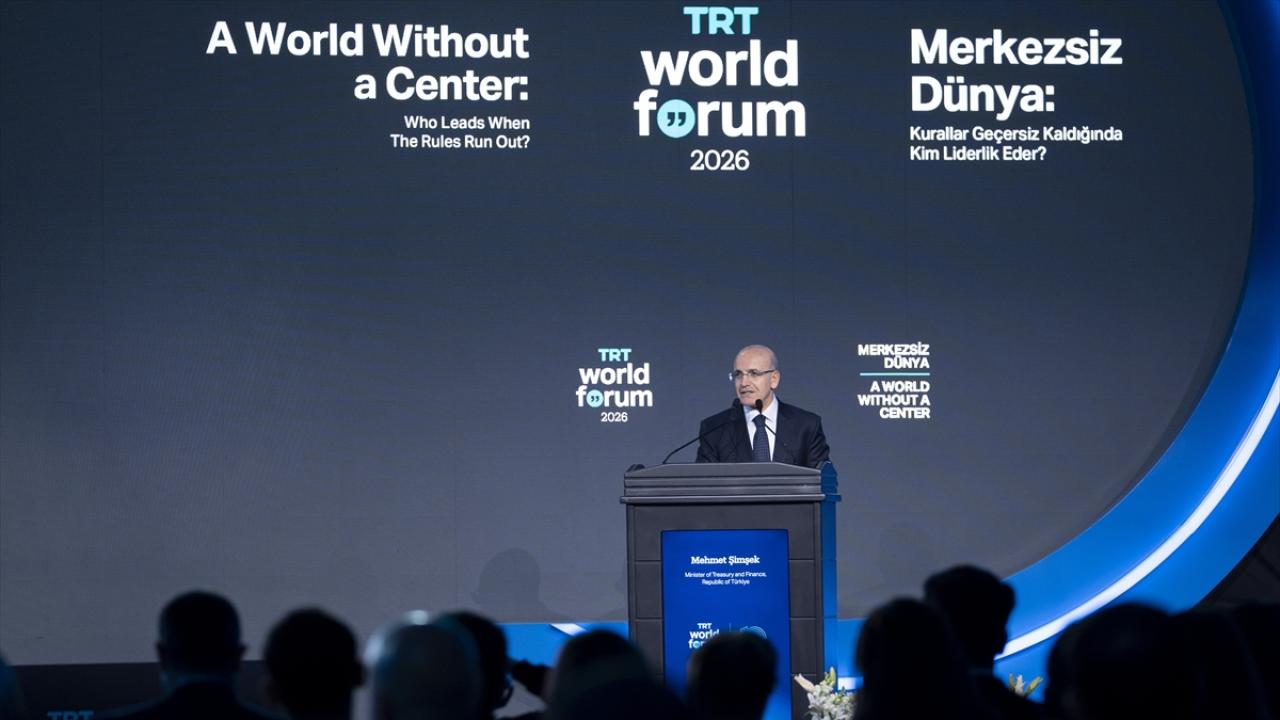
The TRT World Forum, held at the Istanbul Congress Center and hosting global thought leaders under the theme 'A World Without Rules: Who Leads When Rules No Longer Apply?', concluded with striking remarks from Treasury and Finance Minister Mehmet Şimşek. Speaking at the closing session titled 'Towards a Painful Recovery: National Economies After Wars in the Middle East', Minister Şimşek emphasized that regional conflicts cause not only humanitarian tragedies but also profound economic destruction. Şimşek highlighted the pressure of the energy supply shock triggered by the war on the global economy and stated that conflicts must end as soon as possible for a sustainable recovery.
Minister Şimşek pointed to the sharp decline in the foreign trade volumes of countries on the front lines of the conflict, noting that the effects of the war are multiplying in a conjuncture where global growth is slowing and financial conditions are tightening. Şimşek argued that regional actors must now focus on cooperation rather than competition, otherwise economic recovery will become impossible. This vision stands out as an approach that reaffirms Turkey's role as a 'constructive actor' in the region and its goal of becoming an architect of stability.
Background of the Development
The TRT World Forum has become one of the most important platforms representing Turkey's soft power in the international arena since 2017. This year's forum was held at a time when the global system is evolving into a multipolar structure and existing rules are being questioned. Long-standing geopolitical tensions in the Middle East are directly hindering the economic development goals of regional countries. Historically, the Middle East has always been the focus of global powers due to its energy resources and strategic transit points. However, the conflicts experienced in recent years have paralyzed supply chains and logistics networks, disrupting the foreign trade balances of regional countries.
As Minister Şimşek emphasized, the atmosphere of uncertainty created by the war is slowing down capital flows by shaking investor confidence. Although the Gulf Cooperation Council (GCC) countries can manage this process more resiliently thanks to their financial reserves, it is evident that a 'painful recovery' process is being experienced throughout the region. Structural uncertainties in countries like Iran and physical destruction in conflict zones stand out as the biggest obstacles to regional integration.
Developments recorded on similar issues in previous periods and regulations made within the legal framework have determined the main outlines of the current picture. When the chronological course of the event is examined, it is seen that the operational parameters followed by decision-makers for a long time have reached a critical threshold at this stage. When the factors playing a role in the development of the process are examined, the vital importance of information flow and institutional coordination among stakeholders is understood once again.
Expert and Industry Insights
Economic experts agree that Minister Şimşek's call for 'regional cooperation' is a strategic necessity. According to experts, excessive dependence on critical transit points such as the Strait of Hormuz poses a serious security risk for regional countries. Reducing this risk is only possible by diversifying regional trade networks and integrating logistics infrastructures. Industry representatives state that the current picture contains both operational challenges and strategic opportunities.
The main parameters that expert groups focus on with sensitivity are as follows:
- Economic integration models similar to a customs union should be developed to increase regional trade volume.
- Renewable energy investments and regional energy grids should be established for energy supply security.
- Common financing mechanisms should be created for post-conflict reconstruction processes.
- Railway and road corridors should be diversified to reduce logistics dependence.
- Tighter coordination should be ensured between central banks to maintain financial stability.
These evaluations show that the economic future of the region depends not only on oil prices but also on political stability and the will for regional cooperation. The inclusion of independent audit mechanisms and objective data analysis in the process stands out as the most important element that will strengthen the environment of mutual trust between the parties.
Economic and Social Implications
The economic effects of the war are not limited to macro data; they also leave deep marks on social welfare. Rising inflation and tightening financial conditions directly reduce the purchasing power of the people in the region. As Minister Şimşek stated, it is very difficult for the global economy to withstand this picture. In particular, the decline in import and export volumes makes it difficult for local producers to access the market. Market actors expect official authorities to provide a clear and predictable framework to resolve uncertainties.
On the other hand, the efforts of regional actors to reduce their dependencies can create a more resilient economic structure in the long run. However, this transformation requires a serious cost and social adaptation process in the short term. Maintaining public balances has become a priority agenda item for governments. On the social dimension, public awareness and sensitivity to the issue are at a high level. The fact that decision-making processes directly touch upon social welfare, labor rights, and consumer safety shows that the human dimension of the process can never be ignored.
The correct use of the sectoral information pool and stakeholder consultations will play a key role in the healthy progress of the process. Well-structured regulations will play a key role in increasing the general resilience of the sector. Transparent dialogue to be established with social stakeholders will strengthen the social acceptance of the steps taken.
Future Projections and Outlook
In the coming period, regional countries are expected to follow a 'risk management' oriented strategy. As Minister Şimşek pointed out, the development of alternative routes to the Strait of Hormuz and the strengthening of regional economic integration will be the main agenda items of the coming years. This process requires not only economic but also diplomatic success. Official processes are expected to proceed in parallel with the establishment of regional peace.
If the conflicts end, there is potential for regional countries to make an economic leap with massive infrastructure projects. However, risks are still on the table; the escalation of geopolitical tensions could disrupt all these projections. New regulations and audit results to be announced within the scope of strategic action plans will build the foundation for a long-term transformation. Official statements to be made by decision-makers by taking into account public expectations will disperse the clouds of uncertainty.
In conclusion, Turkey's role as a 'constructive actor' in the region will play a key role in ensuring economic integration. Minister Şimşek's messages reflect Turkey's vision of being not just a market, but also an architect of regional stability and prosperity. As the Bilginet News Desk, we will continue to follow all the hot developments in the field regarding this process, verified agency data, and expert evaluations; and we will continue to convey them to our readers with an objective, impartial, and principled journalism approach.
💬 Yorumlar 0
Henüz yorum yapılmamış. İlk yorumu siz yazın!





